Heat Transfer Problem and Analysis for Problem Set 4
Problem Set 4:
This problem set taught me many things including how to account for solar irradiation, how to use an energy balance for an extended surface, and gave me practice with a singular fin. Question 2 was useful to me because it allowed me to divulge the use of an energy balance in terms of an extended surface. In our other practice problems, we have used an energy balance quite frequently but this problem presents itself like a classic extended surface problem. In addition to the use of an energy balance to solve for the temperature expression of the surface, the problem shows the importance of M and how it is used to connect between physical parameters and a temperature expression. To find the expression for the qf , Table 3.4 is used.
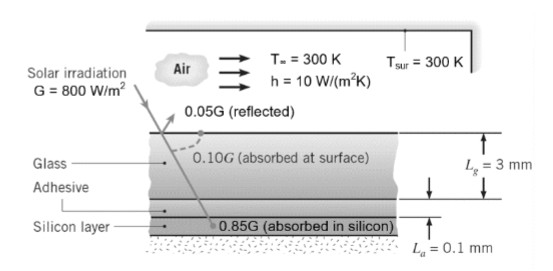
Although I learned a lot from question 2, I learned the most from problem 1. This is a question regarding a three-layered photovoltaic panel with an incident solar irradiation upon it. The bottom layer of silicon will convert the solar irradiation into electricity once it intercepts it. We are given the geometric parameters of the setup, the percentage of absorption for the layers, and other parameters regarding heat transfer. With those, we are tasked with finding the thermal resistance network and the corresponding thermal resistance of each node, the temperature at the top surface of the glass and silicon layer, and the solar-to-electricity conversion efficiency and resulting electricity power flux produced by the panel.
While solving this problem, I learned how to utilize a thermal resistance circuit, how to factor in solar irradiation, and the corresponding electricity power flux produced by the panel. The resistance circuit showed me how different modes of heat transfer require different equations for the thermal resistance. Because a portion of the solar irradiation is reflected, the resistance network had the convective and radiative resistances in parallel at the surface of the glass. Completing this problem gave me good practice in specifying the temperatures and resistances in the circuit based on a schematic diagram. 10% of the solar irradiation was absorbed by the glass layer and 85% of it was transmitted to the silicon layer which added multiple assets to factor into the network which we had not seen yet. As for the electricity power flux in the silicon layer, this was not a process I felt confident in before completing this problem. I used an equation found in the lecture notes to solve for this.
Technologies Used:
Back to Projects